
Published on
Bubble Alternatives in 2026: What You Can Actually Take With You
The best Bubble alternative depends on why you want to leave. If you want to keep building visually but own your code, look at FlutterFlow or WeWeb. If you want AI to write the app, Lovable, Bolt and Replit give you real code. For internal tools, Softr, Glide or Retool are simpler. If the app is your business and you need full control, custom code on an open stack such as Next.js and Supabase is where most growing products end up.
One thing is the same for every option: Bubble can't export your app as code, so switching means rebuilding it. Below we compare the main alternatives by what you can actually take with you, checked against each vendor's own pages on October 16, 2026. About us: we've built on Bubble for 9+ years and launched 50+ apps, and we now also migrate Bubble apps to code, so we have a stake in the last option. Every claim below links to its source so you can check it.
Quick picks by reason for leaving
- You want to own the code but keep a visual editor: FlutterFlow for mobile apps, WeWeb for web apps.
- You want AI to build it: Lovable, Bolt or Replit. You get a real codebase, and someone has to maintain it.
- You're building internal tools or client portals: Softr, Glide or Retool.
- You only need a marketing website: Webflow.
- You're a large company with IT governance: OutSystems or Mendix.
- The app is the business: custom code, for example Next.js with Supabase.
Before you switch: Bubble can't export your app
Bubble's own manual is direct about it: "Bubble apps can only be run on the Bubble platform; there's no way of exporting your application as code" (Bubble manual). You own your designs and your data, and the data can leave as CSV files or through Bubble's Data API.
So no alternative can import a Bubble app. We haven't found a tool that converts Bubble workflows into another platform, and Bubble's competitors say the same: leaving means rebuilding (WeWeb's guide puts it as rebuilding from scratch). Your live Bubble app becomes the specification. Pages, workflows, privacy rules, data types, plugins and integrations all have to be listed and rebuilt.
Two things surprise people most. User passwords can't be exported, because Bubble stores them as one-way hashes, so users set a new password or sign in through Google or another SSO provider after the move. And you can't move the app piece by piece by exporting parts of it; instead you rebuild modules one at a time while Bubble keeps running. Our Bubble to code migration page covers that process in detail.
How much of your app you can take with you
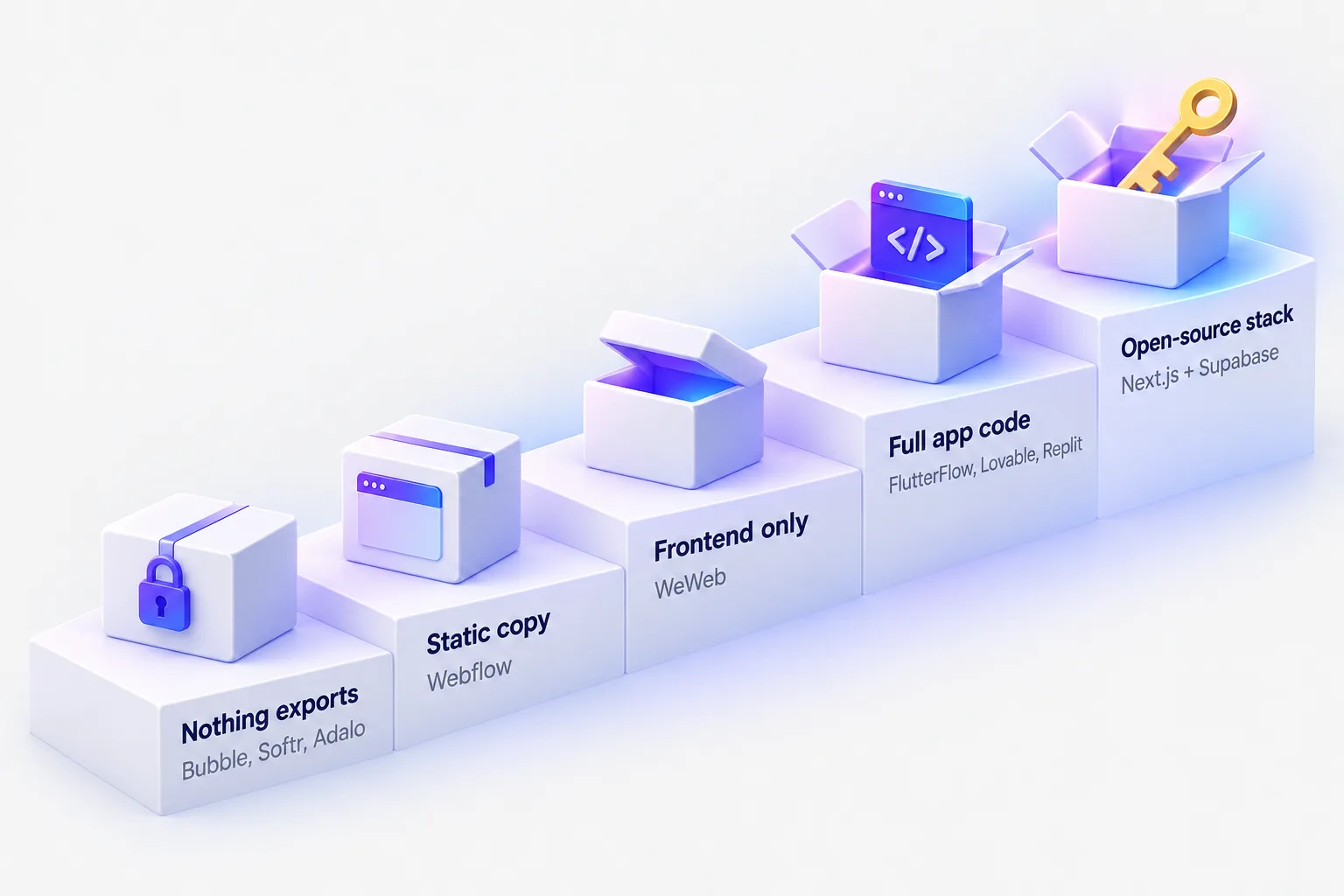
"Can I export my code?" has five different answers across these tools. Think of it as a ladder:
- Nothing exports. The app only runs on the platform: Bubble, Softr, Adalo, and Glide below its Enterprise plan.
- A static copy exports. Webflow exports HTML and CSS, but not CMS content, forms or site search.
- The frontend exports. WeWeb exports a Vue.js single-page app you can host yourself, though some WeWeb plugins stop working outside WeWeb.
- The full app code exports. FlutterFlow (Flutter and Dart), Lovable, Bolt and Replit give you a codebase you can run elsewhere.
- The stack itself is open source. With custom code on open-source tools such as Next.js (MIT license) and Supabase (Apache-2.0), no part of the stack belongs to a single vendor.
The higher you go, the more freedom you get, and the more of the app's upkeep becomes your job. That trade-off matters more than any feature list.
Bubble alternatives compared (checked October 2026)
| Tool | Code you can take | Self-hosting | Native mobile | Lowest paid plan |
|---|---|---|---|---|
| Bubble | None | No | Yes (beta) | $29/mo web plan, billed annually |
| FlutterFlow | Flutter/Dart code (Basic plan and up) | Yes, exported code | Yes | $39/mo |
| WeWeb | Vue.js frontend (paid plans) | Yes | No (PWA) | $20/mo plus hosting |
| Lovable | Full code via GitHub sync | Yes, exported code | No | $25/mo |
| Bolt.new | Full code via GitHub sync | Yes, exported code | Via Expo | $25/mo |
| Replit | Full code (zip or GitHub) | Yes, exported code | Via Expo (App Store) | $20/mo |
| Softr | None | No | No (PWA on Business) | $19/mo |
| Glide | None below Enterprise | No | No (PWA) | $25/mo (GlideOS) |
| Adalo | None | No | Yes | $36/mo, billed annually |
| Retool | No standalone export | Yes, all plans | Yes | $10 per builder/mo, billed annually |
| Webflow | Static HTML/CSS, no CMS | Static export | No | $15/mo site plan, billed yearly |
| OutSystems | .NET detach (OutSystems 11 only) | OutSystems 11 | Yes | Not published |
| Mendix | No runnable export | Extra cost | Yes | €918/mo |
| Next.js + Supabase | All of it | Yes | Via Expo or PWA | No license; hosting from about $45/mo |
Prices are the lowest paid plan shown on each vendor's pricing page on October 16, 2026. Many vendors show annual-billing prices by default, and monthly billing usually costs more. Custom-code hosting assumes Supabase Pro ($25) plus Vercel Pro ($20); development is the main cost there. Xano and Supabase are backends, covered further down.
Visual builders that export code: FlutterFlow and WeWeb

FlutterFlow is the closest to Bubble for teams that care about the app stores. You build visually, and from the Basic plan ($39/month) you can download the full Flutter source code; GitHub sync starts on the Growth plan (FlutterFlow pricing). You bring your own backend, usually Firebase or Supabase. It suits mobile-first products whose team can take over a Flutter codebase later.
WeWeb is a visual builder for web apps such as dashboards and portals. On paid plans, from $20/month plus hosting, you can export the frontend as a Vue.js single-page app and host it anywhere (WeWeb code export). Since April 2026 it also has its own Postgres-based backend, or you can connect Supabase or Xano. Read the caveats first: you can't re-import an export, and plugins that rely on WeWeb's own services, such as Stripe, OpenAI and WeWeb Auth, stop working when you self-host (WeWeb docs).
AI app builders: Lovable, Bolt and Replit

These tools build the app from a chat. Unlike Bubble, they produce ordinary code that you can take with you, and Bubble's own comparison pages concede that point (Bubble vs. Lovable).
- Lovable builds web apps. Your code syncs to GitHub on every plan, and zip download is on paid plans, with Pro from $25/month. New projects use TanStack Start with Lovable Cloud, a backend built on Supabase. It doesn't produce native mobile apps (Lovable FAQ).
- Bolt.new builds web apps and, through Expo, iOS and Android apps. Code syncs both ways with GitHub (Bolt docs). Pro starts at $25/month.
- Replit pairs an AI agent with a cloud IDE, hosting and a built-in Postgres database. You can download the code or sync it with GitHub. Mobile apps go through Expo: publishing to Apple's App Store works from Replit, Google Play publishing doesn't yet (Replit docs). Core is $20/month.
The catch is ownership in the other sense: you own the code, so you also own its bugs, security and upkeep. AI builders get you to a working app fast; keeping a growing product healthy still takes someone who can read the code. Usage credits can also be hard to forecast, the same complaint many teams have about Bubble's workload units.
Internal tools and portals: Softr, Glide and Retool
If your Bubble app is really an internal tool or a client portal, a dedicated tool may be simpler and cheaper than any rebuild.
- Softr builds portals and business apps on its own database or on Airtable, Google Sheets, HubSpot and SQL sources. Plans start at $19, there's no code export, and the installable mobile app (a PWA) is on the Business plan (Softr pricing).
- Glide turns spreadsheets and other data sources into internal apps. Its newer product, GlideOS, starts at $25/month, and viewing the generated code is an Enterprise feature (Glide pricing). Glide apps are web apps (PWAs), not App Store apps.
- Retool is built for admin panels and dashboards on top of your existing databases and APIs. It's free for up to 5 users, Team starts at $10 per builder per month billed annually, every plan can be self-hosted, and it supports native mobile apps. There's no standalone code export (Retool pricing).
Websites, not web apps: Webflow
Webflow is a strong choice when what you built in Bubble is really a marketing or content site. It isn't an app builder: it has a CMS but no app database, and it retired its User Accounts feature on January 29, 2026 (Webflow help). Paid workspace plans can export static HTML and CSS, without CMS content, and forms and site search stop working on an exported site. Site plans start at $15/month billed yearly.
A common setup is Webflow for the marketing site and a separate app on another platform or in code.
Backends you can pair with a builder: Xano and Supabase
Some teams leave Bubble in two parts: a frontend builder plus a separate backend.
- Xano is a hosted no-code backend with a Postgres database, APIs and business logic. It works with WeWeb, FlutterFlow, Lovable and others, but logic is written in Xano's own XanoScript, and self-hosting is only on the custom enterprise plan. Paid plans start at $85/month billed annually (Xano pricing).
- Supabase is an open-source Postgres platform with auth, file storage and realtime. You can self-host it for free with Docker, and the hosted Pro plan starts at $25/month (Supabase pricing). Lovable Cloud runs on Supabase, and Bolt offers it as a database option.
Choosing a portable backend first is a sensible hedge: if the frontend tool doesn't work out, your data and business rules stay where they are.
Enterprise low-code: OutSystems and Mendix
For large organizations with IT governance, OutSystems and Mendix are the usual candidates. Both build native mobile apps and full business systems, and both are priced for companies rather than startups: Mendix Standard starts at €918/month (Mendix pricing), and OutSystems doesn't publish prices.
Neither gives you an ordinary codebase to walk away with. OutSystems 11 has a one-way "detach" process that generates a .NET application (OutSystems docs); we found no documented equivalent for its newer cloud product. Mendix lets you export models and data, not a runnable app.
Custom code: Next.js and Supabase

Custom code is the option with no platform between you and your users. A typical modern stack is Next.js (open source, MIT license) for the app and public pages, Supabase (open source, Apache-2.0) for the database, auth and file storage, and hosting on Vercel or your own servers. Native mobile apps can share the same backend through React Native and Expo.
It costs more to build than a no-code app, and someone has to maintain it. In return, you own everything, public pages are rendered on the server so search engines and AI assistants can read them, and costs follow the infrastructure you use rather than a platform's pricing units. AI builders such as Lovable and Bolt now generate apps on this same family of tools, which says a lot about where apps end up as they grow.
We took this path with our own site: mindforapps.com ran on Bubble until September 2026 and now runs on Next.js and Supabase. If you're weighing it for your app, our Bubble to code migration page explains the options, including when not to migrate.
When staying on Bubble is the right call
Leaving isn't always the answer. Bubble still has real strengths: one visual editor for the whole app, a built-in database, bundled hosting, native mobile apps in beta, and SOC 2 Type II certification. Staying usually makes sense if:
- you're still validating the product;
- the app is internal or behind a login, so search visibility doesn't matter;
- workload-unit usage is stable and inside your plan;
- your team ships quickly in Bubble and nobody wants to maintain code.
If the problem is cost or speed, optimizing the Bubble app is often cheaper than switching. Move when several limits hit at once, or when you need to own the code.
How to choose: four questions
- Why are you leaving? Cost, speed, SEO, mobile and ownership each point to a different tool.
- Who will maintain the app? No developers: stay with a visual tool. A developer or an agency: code-based options open up.
- Do you need App Store apps? Look at FlutterFlow, Adalo, Retool or Expo-based builds. Bubble's own native mobile builder is still in beta.
- What must you own? If investors, buyers or compliance require source code, choose from the top two rungs of the ladder above.
Bubble® is a trademark of Bubble Group, Inc. Other product names are trademarks of their respective owners.
Frequently asked questions
What is the best alternative to Bubble?
It depends on why you're leaving. FlutterFlow and WeWeb suit teams that want a visual editor and exportable code; Lovable, Bolt and Replit suit AI-first building; Softr, Glide and Retool suit internal tools; custom code on Next.js and Supabase suits products that need full ownership.
Can I export my Bubble app to another platform?
No. Bubble apps can only run on Bubble, and no other tool imports them. You can export your data as CSV files or through Bubble's Data API, but pages and workflows have to be rebuilt.
Which Bubble alternatives let you export code?
FlutterFlow (Flutter and Dart, from the Basic plan), WeWeb (a Vue.js frontend on paid plans), Lovable, Bolt and Replit (full code via GitHub or download), and Webflow (static HTML and CSS only). Softr, Adalo, and Glide below its Enterprise plan don't export code.
Which Bubble alternatives build native mobile apps?
FlutterFlow, Adalo, Retool, OutSystems and Mendix build native apps, and Bolt and Replit do it through Expo. WeWeb, Softr, Glide and Lovable produce web apps or PWAs. Bubble's own native mobile builder has been in public beta since June 2025.
Are AI app builders like Lovable a replacement for Bubble?
For many web apps, yes: they generate real code you can keep. The trade-off is that you then own and maintain that code, and usage credits can be hard to forecast.
Is Bubble still worth using in 2026?
Yes, for products still validating an idea, for internal tools, and for teams that want one visual platform without maintaining code. It's a weaker fit when you need to own the source code or need server-rendered public pages.